MIRIAD develops a RHINOS variant as an autonomous launcher for interceptor missiles against jet-powered drones
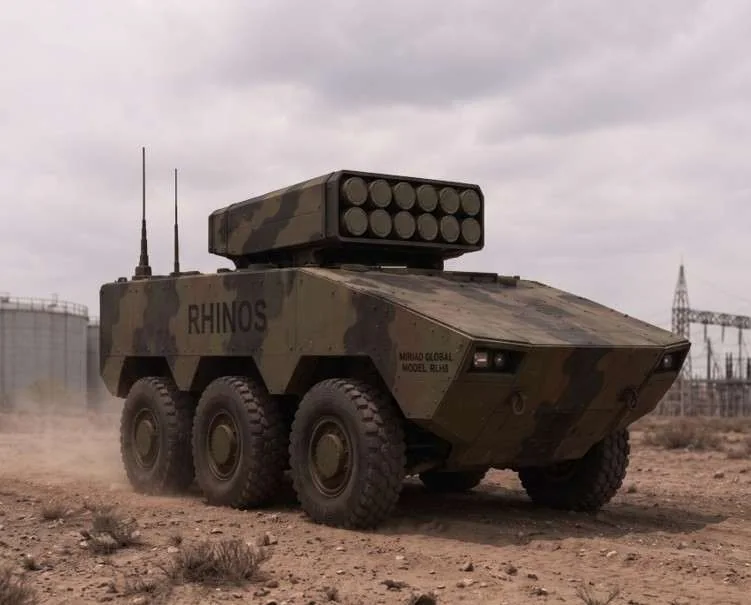
The RHL6 version carries 12 missiles of up to 240 millimetres in diameter and 3.5 metres in length on a trainable module and is compatible with a wide range of light interceptors from different manufacturers
In parallel, MIRIAD Global is working on the development of the STRIKEX interceptor missile against jet-powered drones, an evolution of its STRIKE2 light jet interceptor drone
Madrid, 15 September 2026. – The growing use of jet-powered drones marks the most recent development in modern warfare. Ukraine is a clear example. The era of ‘slow’ propeller-driven drones is over and offensives are now dominated by unmanned aircraft powered by turbojets, which fly three times faster than their predecessors, operate in waves that saturate air defences, reduce interception rates and deplete stocks of conventional interceptor missiles.
The result is growing international demand for launcher solutions able to concentrate a high number of interceptors and to operate autonomously as distributed firing nodes. To meet that need, MIRIAD Global has developed a variant of its RHINOS 6×6 heavy ground vehicle, designed to operate as an autonomous launcher for interceptor missiles against jet-powered drones.
The development, which the Spanish defence industrial group has named RHL6, has an initial configuration of 12 tubes in a 6×2 arrangement, that is, two horizontal rows of 6 missiles each, mounted on a trainable module.
The RHL6 can carry light missiles measuring up to 240 millimetres in external airframe diameter and up to 3.50 metres in length, with a launch sector of approximately 20 to 60 degrees. This architecture ensures compatibility with a wide range of light interceptors and keeps a compact assembly on the RHINOS platform.
MIRIAD Global conceives the RHL6 as a launch system able to accept different configurations of canister and interceptor, which prevents the platform from being tied by design to a single type of munition. The company will make the platform available to several missile manufacturers so that they can assess their possible interest in integrating their own interceptors.
An autonomous launcher against saturation attacks
“The industrial proliferation of jet-powered drones is changing the scale of the problem. Thousands of vectors a month force operators to deploy more interceptors, more firing points and systems able to react within seconds to saturation attacks”, says Antonio Navarro, executive chairman of Miriad Global. The main innovation of the RHL6 comes from the unmanned nature of RHINOS, which transforms what a launcher can do in the field. The vehicle can remain deployed, ready and permanently connected to the tactical network with no crew on board, receive cues from external sensors and move on its own towards the assigned position. Once there, it trains the module, adjusts the launch angle within the planned sector and stands ready to run the firing sequence in seconds.
That level of autonomy is maintained throughout the engagement. The launcher can change position after a fire mission to avoid counter-battery attack, reorient towards another sector, occupy forward or exposed locations that would not be acceptable with crew on board, and remain on prolonged alert without crew rotation or personnel fatigue. The RHL6 therefore makes it possible to deploy a larger number of launchers without a proportional increase in the number of front-line operators.
Navigation, mobility, positioning, module orientation and the technical preparation of the launch can be automated, but firing authorisation remains within the human chain of command.
The LYNKS architecture developed by MIRIAD also shortens the time between the detection of a threat and the effective availability of the interceptor, because pre- launch checks can be carried out remotely.
Modifications to the prototype
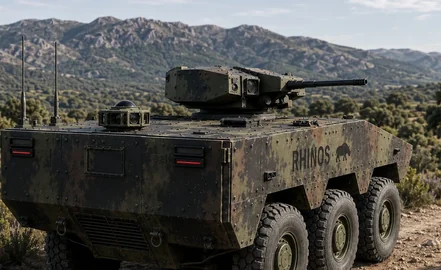
RHINOS was unveiled last June at the Eurosatory global defence exhibition in Paris as MIRIAD’s 6×6 heavy combat ground vehicle, with a length of 5.50 metres, a width of 2.50 metres, a height of 1.70 metres, an approximate mass of 10.5 tonnes and a payload capacity of up to 3.5 tonnes. The company announced at the time that it was working on new configurations of the platform, including missile-launcher variants.
MIRIAD Global engineers are already working on modifications to the RHINOS dimensional prototype, currently under construction, so that the combat version to be presented in early 2027 is compatible with this new RHL6 variant. The aim is to maintain a common vehicle architecture so that RHINOS can move between different combat configurations by replacing its mission systems.
The STRIKEX interceptor missile against jet-powered drones
In parallel, the MIRIAD Global team is working on the development of the STRIKEX interceptor missile against jet-powered drones, an evolution of its STRIKE2 light jet interceptor drone, which was also presented last June.
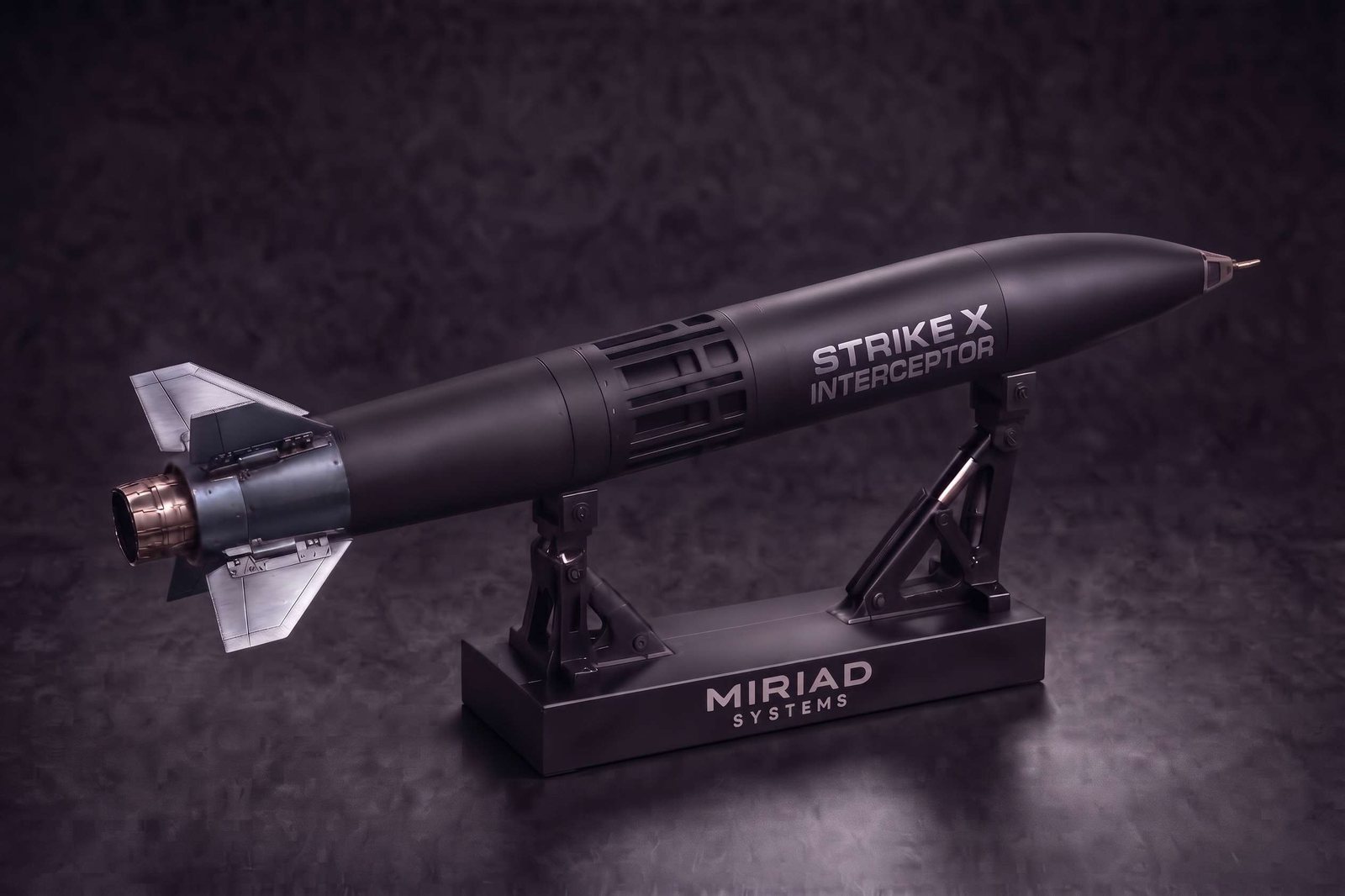
STRIKEX will have an estimated mass of 50 kilos, around 5 kilos of warhead and a target range of 100 kilometres. It has been designed specifically to bring down new- generation jet-powered drones flying at more than 600 kilometres per hour, as well as cruise missiles, including supersonic ones.
STRIKEX will use cold launch from a canister. The interceptor leaves the tube first and its turbine starts up once it has reached a safe separation from the vehicle.
MIRIAD Global expects the missile to reach supersonic speeds during the interception phase, which widens its engagement capability against fast, low- altitude threats.
The new interceptor will build on the experience gained with STRIKE2 and will evolve its guidance architecture. It will receive information from external radars, will apply artificial intelligence to a tactical mission memory and will feature a specifically developed version of the TARGOS seeker, adapted to the new flight regime and to higher closing geometries.
TARGOS was also presented in June as an EO/IR seeker able to detect, classify and track the target during the terminal phase through onboard artificial intelligence. It incorporates salvo coordination algorithms designed to distribute targets and coordinate the simultaneous use of several interceptors against swarms or saturation attacks.
RHL6 and STRIKEX respond to the same need: more interceptor systems deployed, more firing nodes, shorter reaction times and a distributed architecture able to sustain combat against waves that are now produced on an industrial scale.
About MIRIAD Global
MIRIAD Global is a Spanish defence industrial group backed by Funditec and specialised in unmanned systems, advanced subsystems, mission electronics and industrial integration. It brings together its own technological and industrial capabilities in design, engineering, software, manufacturing and integration, applied both to the development of complete systems and to the supply of critical subsystems and electronics to third parties within national and European defence programmes. With centres in Madrid, Málaga, Getafe and San Fernando de Henares, and industrial agreements in Catalonia and the Basque Country, its activity focuses on autonomous ground, air and naval platforms, as well as on onboard artificial intelligence, mission computers, control electronics and other critical systems. Its industrial model rests on the progressive integration of complementary productive and technological capabilities in order to strengthen an industrial and technological base in Spain with a real capacity to deliver major defence programmes.