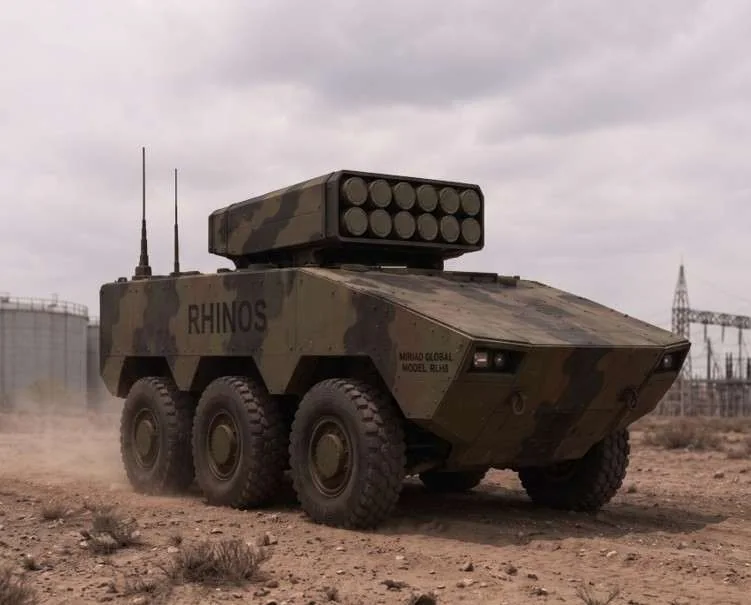
Miriad Global starts building the first RHINOS prototype, a heavy 6x6 UGV for fire support and manoeuvre protection in high-intensity combat
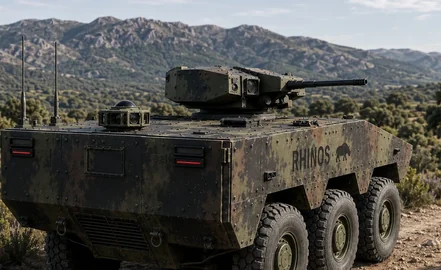
The prototype will be unveiled at the end of the year together with the new HORN30 weapon system
Paris, 17 June 2026. – Miriad Global has commissioned Ferrimax to build the armoured hull of the first RHINOS prototype. This autonomous 6×6 armoured vehicle is designed to operate alongside crewed formations and robotic groups in areas under enemy fire and to reduce crew exposure in high-intensity combat scenarios.
Platform and technical characteristics
RHINOS sits in the heavy segment of Miriad’s land ecosystem. In its planned configuration, the platform is 5.50 metres long, 2.50 metres wide and 1.70 metres high, with a mass of 10.5 tonnes and a maximum payload of 3.5 tonnes. It is an armoured 6×6 UGV with electric propulsion and an EREV diesel range extender. It features STANAG 4569 Level 3 protection with a reinforced front, a top speed of up to 90 km/h on road and around 45 km/h off road, and a fording capability of 1.5 metres. It also carries a 180 kWh LiFePO 4 battery and a 220 kWe militarised diesel generator.
The 2.50-metre width is one of the key design features. It keeps the vehicle transportable by conventional means on low-loaders, rail and standard logistics platforms. This footprint makes it easier to move several units strategically and operationally without resorting to special oversize transport. As a result, the vehicle combines protection, usable volume and weapon integration with logistical mobility suited to rapid deployments, trials, rotations and concentration of forces.
Ferrimax will build the armoured hull at its plant in Sant Fost de Campsentelles, Barcelona, and Miriad will assemble the final prototype at its prototyping plant in San Fernando de Henares, Madrid. In this first phase, the prototype is dimensional. It will be used to validate the geometry, the fit and physical integration of subsystems, and the transportability of the platform.
Autonomy, communications and situational awareness
The vehicle’s architecture provides for autonomous operation in GNSS-denied environments, teleoperation via fibre-optic cable up to 20 km, resilient tactical links, relay/swarm capability and MUM-T operation integrated into LYNKS, Miriad’s command, control and mission software layer. The ability to operate over fibre optics is especially relevant in scenarios of intense electronic warfare, GNSS degradation and electromagnetic contestation, where link continuity is critical to sustain the manoeuvre.
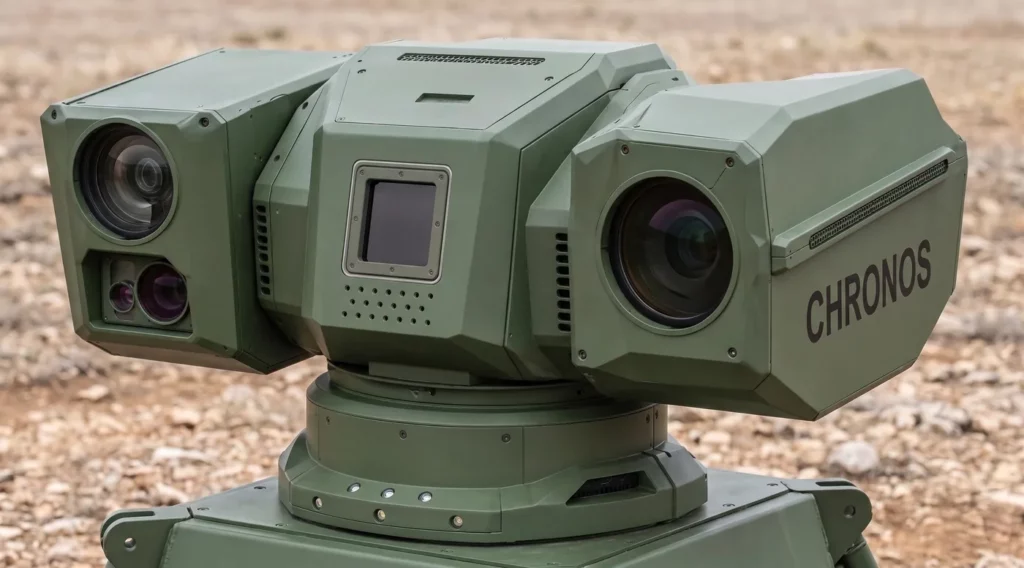
The situational awareness of RHINOS is based on SAIS, Miriad’s intelligent suite. It provides passive event detection, detection and classification of acoustic patterns, onboard multi-sensor fusion and operator assistance. Together with the perimeter cameras, SAIS allows the platform to keep watch over its surroundings even with degraded visibility, electronic warfare pressure and drone saturation.
This layer makes RHINOS more than an armed platform. The vehicle receives orders and delivers fire. It also keeps constant watch over its immediate surroundings, shares tactical information with the rest of the group and helps sustain the manoeuvre under conditions of high operational uncertainty.
RHINOS COMBAT and the HORN30 remote weapon station
The main variant, RHINOS COMBAT, is focused on fire support and manoeuvre protection.
The platform will integrate the HORN30 remote weapon station developed by Miriad Engineering, which the company plans to present publicly on RHINOS at the end of the year. HORN30 uses 30×113 mm ammunition and has a rate of fire of up to 750 rounds per minute. It is designed to provide close-range direct fire, counter-FPV defence and a response to mini-UAS and low-altitude aerial threats. It can also engage infantry, light vehicles, exposed positions and enemy support teams.
Responding to the lessons from Ukraine
Work on the prototype begins at a time shaped by the lessons of the war in Ukraine. The combination of FPV drones, loitering munitions, mines, persistent surveillance, electronic warfare and precision artillery has turned the contact zone into a transparent and lethal space. In that environment, crewed vehicles that hold firing positions or accompany the manoeuvre become priority targets. RHINOS addresses this problem by shifting part of the risk to the unmanned system. It can occupy exposed positions, protect corridors, cover crossing points and provide immediate fire without putting crews at risk.
Its main mission is fire support for crewed or robotic formations. RHINOS COMBAT is designed to accompany sections, platoons and manoeuvre groups, providing a heavy layer of direct fire, counter-FPV protection and low-altitude defence. In MUM-T operations it can integrate with tanks, combat vehicles, mechanised units or convoys. It receives target designations from the supported formation and delivers the effect where the unit commander orders. In robotic groups it acts as a fire and protection platform alongside reconnaissance, route clearance, sustainment and counter-drone escort systems.
RHINOS is not a standalone platform. It is the heavy tier of a family whose flagship product is TAURUS. In its RECON variant, TAURUS acts as a platform for advanced reconnaissance, sensing, tactical picture distribution and group coordination. In Miriad’s concept of use, TAURUS RECON detects, classifies and distributes operational information, while RHINOS provides the heavy tier of fire support and manoeuvre protection. Coordinated by LYNKS, the combination of these platforms seeks to build a real operational architecture rather than a collection of isolated vehicles.
Multi-effector evolution and operational role
Miriad plans to evolve RHINOS towards multi-effector configurations. In addition to HORN30, the platform has room to integrate short-range missile launchers depending on the operational requirement, including anti-tank or short-range air defence solutions. This architecture would allow RHINOS to be adapted to fire support, manoeuvre protection, defence of forward units or the integration of specialised effectors.
The family also includes an amphibious variant, SEA RHINOS, designed for littoral operations and amphibious assault. It brings the heavy unmanned architecture of RHINOS to the littoral environment. It can support the first wave and protect the beach, and take part in amphibious operations where unmanned platforms take the first exposure to enemy fire.
About Miriad
Miriad Global is a Spanish defence industrial group, majority-owned by Funditec, specialising in unmanned systems, advanced subsystems, electronics and industrial integration. It has its own technology and industrial capabilities in design, engineering, software, manufacturing and integration. It applies them both to the development of complete systems and to the supply of critical subsystems and electronics to third parties in national and European defence programmes. With centres in Madrid, Málaga and San Fernando de Henares, and industrial agreements in Catalonia and the Basque Country, its activity focuses on land, air and naval autonomous platforms. It also covers onboard artificial intelligence, mission computers, control electronics and other mission-critical systems. Its industrial model is based on the progressive integration of complementary production and technology capabilities. The aim is to strengthen an industrial and technological base in Spain with a real capacity to deliver major defence programmes.
Other press releases
-
September 15, 2026
RHL6, autonomous launcher on RHINOS