CHRONOS, the cognitive electro-optical sensor that can identify and neutralise jet-powered drones
MIRIAD Global expects to deliver the first units of this subsystem by the end of the year. It can be integrated into the group’s own ground platforms and those of third parties
Unlike traditional optronic devices, CHRONOS detects threats and raises the alert without emitting radio frequency or giving away its own position.
Madrid, 29 June 2026. – Spanish defence industrial group MIRIAD Global has developed CHRONOS, a new cognitive, stabilised and multimodal electro-optical sensor. It can identify and neutralise high-speed drones without emitting radio frequency or revealing the system’s own position.
CHRONOS responds to a constantly evolving threat. Small, fast, autonomous or radio-silent drones make radio frequency detection less effective when the threat does not emit. Against them, active radar forces a trade-off in electromagnetic exposure, saturation and reaction time.
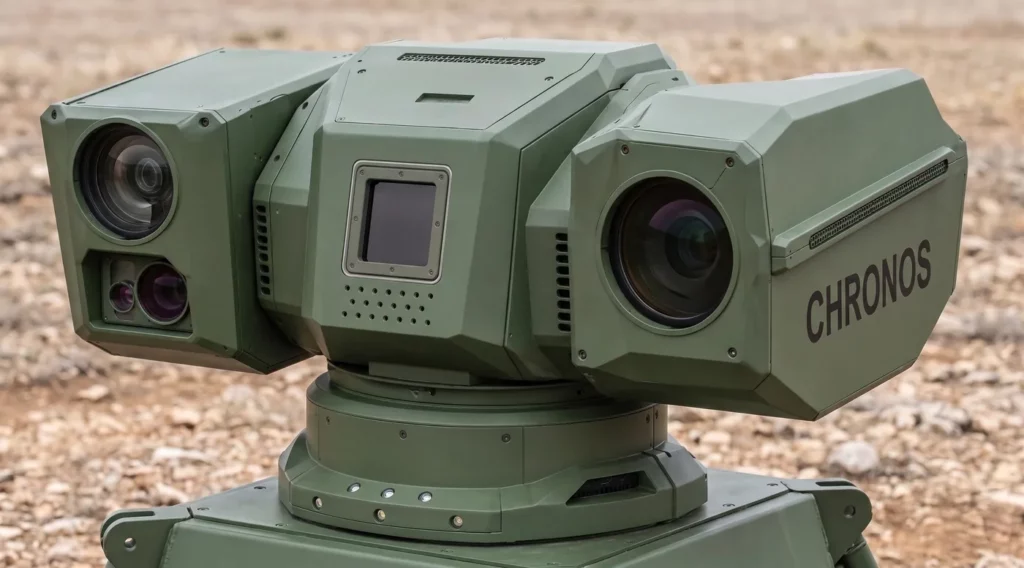
Developed by MIRIAD Engineering, MIRIAD Global’s subsystems division, CHRONOS combines a high-definition camera, thermal channels, a laser rangefinder, multimodal perception and onboard artificial intelligence in a single stabilised head.
Using this combination of optical, thermal and acoustic signals and AI, CHRONOS detects the threat and provides a response geared to its neutralisation. First it points its optics towards the threat’s location. It then classifies, tracks and prioritises it on board. Instead of delivering only raw video, it generates a localised tactical track.
CHRONOS designates the target and passes the alert to whichever element the operator chooses, whether a weapon station, a laser effector, a radio frequency jammer or a command and control post. This effector independence is another key feature of CHRONOS. It also makes possible its integration into third-party platforms or systems already in service, without users having to replace the equipment they already have. Neutralisation always remains subject to the operator’s decision, in line with the rules set by their chain of command.
What sets it apart: seeing and hearing without emitting
The main difference between CHRONOS and traditional electro-optical systems is that, in the latter, the alert always comes from outside (via radar, radio frequency, command and control systems or remote processing). Detection based on active radar gives away the system’s position. Drones with electronic support sensors can triangulate it within seconds, and anti- radiation loitering munitions can then strike it.
CHRONOS, by contrast, can generate the alert on its own while keeping its electromagnetic signature to a minimum, so it is also effective in environments saturated by electronic warfare. Its dual thermal band, acoustic channel and onboard artificial intelligence allow it to detect, classify and prioritise targets without emitting radio frequency or relying on external designation chains. Its sensors also reach what radio frequency cannot pick up when the threat does not emit, and what active radar can only detect at the cost of electromagnetic exposure and reaction time. That is the radio-silent drone, which emits no radio frequency signal at all but still gives off heat and sound.
How it works: artificial intelligence at the speed of the threat
Against a fast drone, reaction time is everything. In fact, CHRONOS takes its name from the Greek concept of time, because in the defence against fast drones survival depends on compressing the response cycle as much as possible. CHRONOS makes it possible to compress that cycle to the minimum against jet-powered drones designed to leave no clue as to where to aim. And that cycle starts with looking in the right place at the right moment.
The onboard artificial intelligence thus turns optronics into a filtering and prioritisation node that reduces false alarms, cognitive load and dependence on expert operators. That is why the first thing CHRONOS’s electronics decide is where to look. It points its identification optics at the threat from the very first cue, without waiting for a radar or an operator to indicate the bearing.
Once the target is locked, CHRONOS fuses its optical and acoustic channels and resolves on board the classification, the rejection of thermal clutter from the terrain, the tracking of multiple simultaneous threats and their prioritisation by approach vector and estimated time to impact. The AI card housed in the head itself performs this work in the sensor. As a result, the rest of the system does not receive a raw image that still needs to be interpreted. It receives a threat that has already been detected, classified and prioritised.
When the data enters the operator’s command and control chain, the decision has already matured and the response process starts earlier. This edge cognition, developed by MIRIAD Engineering, is the core of the system and what makes CHRONOS suited to intercepting high- speed drones and drone swarms.
“Drones are becoming faster, more lethal and more autonomous, and against that the reaction window is measured in milliseconds. The only possible answer is for intelligence to sit in the sensor itself, to understand and resolve the threat the instant it appears, and to leave the decision to engage it to the operator. That is the cognitive approach behind CHRONOS and the direction of all MIRIAD subsystems,” explains José Molins, Managing Director of Miriad Engineering.
Technical specifications
CHRONOS brings all its sensors together in a single head. The central body houses the wide- field uncooled long-wave thermal camera. It acts as a permanent surveillance channel, stabilised relative to the horizon, on a continuous 360° azimuth base. On the sides, the steerable channels handle fine pointing, identification, tracking and designation, with elevation from -20° to +70°. They include a high-definition colour day camera with continuous zoom and thermal fusion, a third-generation cooled mid-wave narrow-field thermal camera and a long-range eye-safe laser rangefinder. A high-dynamic-range acoustic channel completes the set.
Channel processing and fusion take place on board, on the AI card embedded in the head itself. Under reference conditions, CHRONOS delivers detection, recognition and identification ranges against a NATO standard target of around 15/10/7 km in the day channel and 12/8/5 km in the thermal channel, with automatic multi-target tracking. CHRONOS designates the target with operator authorisation and integrates through open standards, using SOSA profiles over Ethernet. It is also ready for TSN and the NGVA interface.
A smart sensor for Spanish and European drone walls
The counter-drone architectures that Spain and Europe are accelerating will require a series of complementary layers, including radar, radio frequency, optronics, acoustics, command and control and effectors. CHRONOS provides the passive cognitive optronic layer that is currently missing. It enables target acquisition, classification and designation without emitting radio frequency, with low latency between the first cue and the assignment of a response.
This capability can be mounted wherever it is needed. It can sit on the retractable mast of reconnaissance vehicles, on fixed stations protecting bases, critical sites and borders, and on board crewed and autonomous vehicles. MIRIAD Global plans to deliver the first CHRONOS units by the end of 2026.
About MIRIAD Global
MIRIAD Global is a Spanish defence industrial group, majority-owned by FUNDITEC, specialising in unmanned systems, advanced subsystems, electronics and industrial integration. It has its own technology and industrial capabilities in design, engineering, software, manufacturing and integration. It applies them both to the development of complete systems and to the supply of critical subsystems and electronics to third parties in national and European defence programmes. With centres in Madrid, Getafe, Málaga and San Fernando de Henares, and industrial agreements in Catalonia and the Basque Country, its activity focuses on land, air and naval autonomous platforms. It also covers onboard artificial intelligence, mission computers, control electronics and other mission-critical systems. Its industrial model is based on the progressive integration of complementary production and technology capabilities. The aim is to strengthen an industrial and technological base in Spain with a real capacity to deliver major defence programmes.
Other press releases
-
September 15, 2026
RHL6, autonomous launcher on RHINOS